

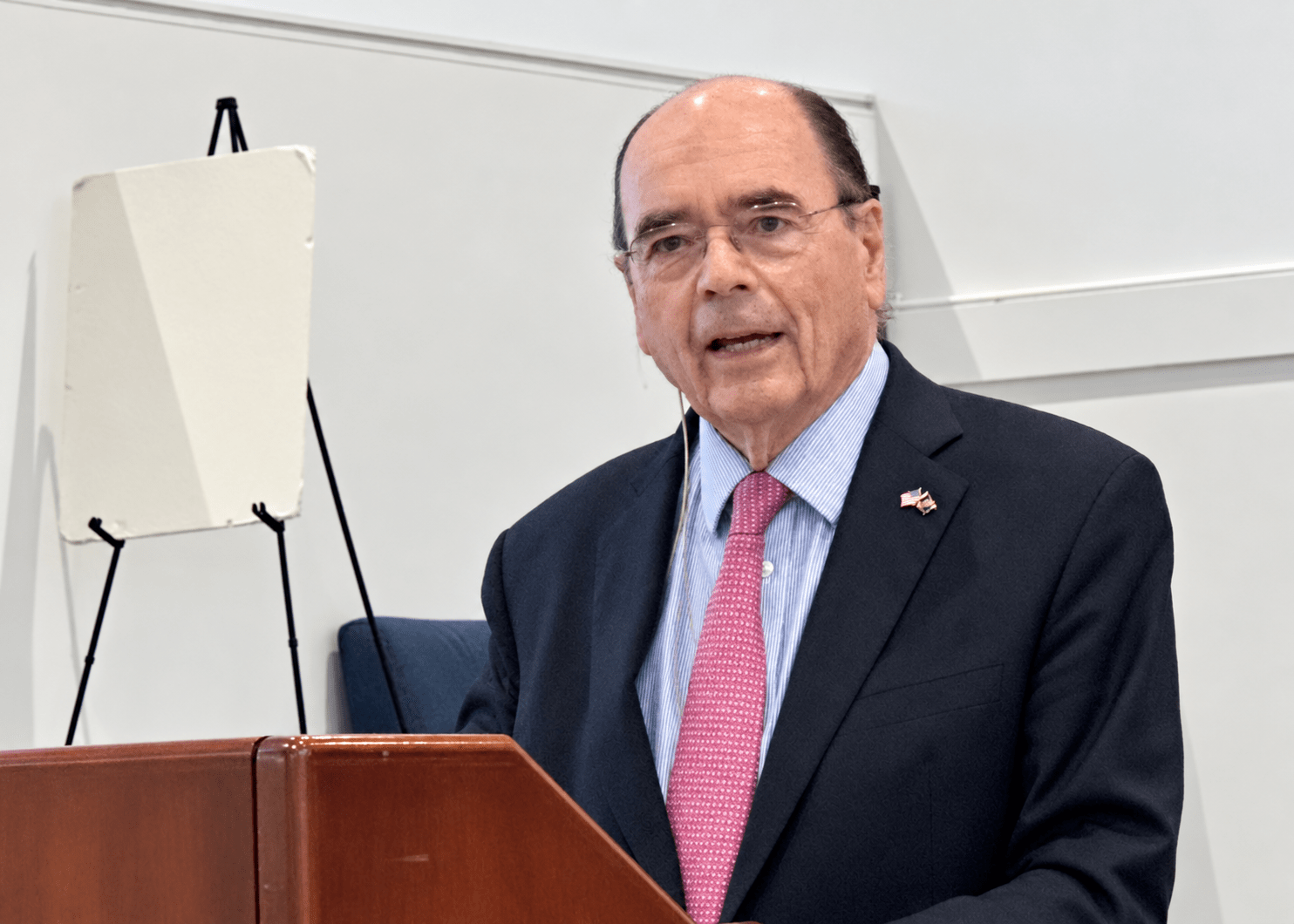
What is needed as soon as possible is a bipartisan, bicameral fiscal commission, established by Congress and approved by the President, charged with getting the deficit back to three percent of GDP over time.
By Tim Brooks
At the September 16th meeting of the Retired Men’s Association speaker, Jim Lockhart opened with the story he told in every government job he has held, at the Pension Benefit Guaranty Corporation, at Social Security, and while overseeing Fannie Mae and Freddie Mac. An aircraft carrier he called the USS Franklin Delano Roosevelt, after the father of Social Security, is steaming through fog with its radar out when the captain gets a message to turn hard to port (“rather than hard to starboard, because I wanted to be bipartisan”). The admiral storms to the bridge: “Who do you think you are, telling a three-star admiral what to do?” A tentative answer comes back: “I’m a second-class Coast Guard petty officer manning a lighthouse. If you don’t change course, you’ll run aground.”
Introduced by Bob Meaney as a Greenwich resident, an RMA member, and a former U.S. Navy nuclear submarine officer, Jim was from 1989 Executive Director of the Pension Benefit Guaranty Corporation, then Principal Deputy Commissioner and Chief Operating Officer of Social Security, then Director of the Federal Housing Finance Agency, and served on the TARP Oversight Board through the 2008-2009 financial crisis. In the private sector he sat on four public-company boards, including Virgin Money in the UK, and was Vice Chair of WL Ross & Co. from 2009 to 2018. He is a former Chair of the Bruce Museum and a Senior Fellow at the Bipartisan Policy Center, where he co-chaired its Commission on Retirement Security. He holds a Yale BA and a Harvard Business School MBA, and is the author of the recent book “America: Underwater and Sinking.”
He had last spoken to the RMA on the same subject three years ago. The country has backslid since, he said, and the admiral has not turned around. The numbers came fast, in trillions. Deficits run $2 trillion a year, and total federal debt has passed $40 trillion, 122 percent of GDP. The 10-year Treasury, the rate that drives mortgages, touched five percent for the first sustained time since 2007, and Treasury Secretary Scott Bessent, he noted, has warned the President that “the bond market has taken out more governments than howitzers.” “I wish someone in command would pay attention.”
Borrowing Ben Bernanke’s line that the federal government is “an insurance company with an army,” Lockhart counted more than 150 federal insurance programs, covering cows, trees, and art along with health and retirement, and showed a spending line pulling steadily away from revenue, with interest costs climbing the list. On the current path the Treasury’s own long-range projection reaches 576 percent of GDP in 75 years. “Well before then, you’re a third-world country.”
Recognizing that he was talking to a retired men’s organization, Lockhart turned to Social Security, which turned 91 in August and which, he said, will never be on a sustainable path until it is fixed. Benefits paid last year were about $1.6 trillion against $1.4 trillion collected, the difference drawn from the trust fund. Al Gore’s “lockbox” will be empty within six years. This year’s trustees report moved the date from 2033 to 2032, partly on lower birth and immigration assumptions and partly because this year’s budget bill cut the income tax on benefits that had been feeding the fund.
When it runs dry, benefits are cut 22 percent across the board, and Connecticut, he showed, will take the biggest average cut of any state, $556 a month. Nobody has fixed the program since Reagan and Tip O’Neill in 1983, and in Lockhart’s telling Presidents Biden and Trump have each made the arithmetic worse, “doing something that’s very easy in Washington, buying votes.” “Every president seems to say, ‘I’m going to protect Social Security, and I’m going to protect it by doing nothing’.” A proposal to pay a $5,000 dividend to every adult, floated the week before, would cost $1.2 trillion.
Lockhart did not leave the room without hope. Against a photograph of a much younger submariner aboard the USS George Washington Carver (“I had a lot more hair in those days”), he made the point of his book’s title: it is time to surface. What is needed as soon as possible, he argued, is a bipartisan, bicameral fiscal commission, established by Congress and approved by the President, charged with getting the deficit back to three percent of GDP over time, from the six percent gap between spending and revenue today.
Nine years ago he co-chaired a Bipartisan Policy Center commission with former Senator Kent Conrad whose package would have fixed Social Security “forever”: gradually raise the retirement age, make benefits more progressive while raising them for the lowest earners, adopt a more accurate price index, and gradually raise both the payroll tax and the cap on taxable wages. Half the fix would be from taxes and half from benefits. The same commission should take on Medicare, Medicaid, the discretionary programs that survive only because one congressman loves them, and tax deductions. DOGE, in his view, cut in the wrong places. “We need to start now.”
Asked to explain budget reconciliation, which the White House has said it would use to fund the $5,000 checks, he said it was meant to pay for itself and now carries “so many goodies,” and gave his humble opinion that the dividend would never pass. Hollister Sturges asked about the understaffed IRS. Having met its new chief executive three months earlier, Lockhart said the claim of doing as much with less staff is simply not true: audits have fallen, taxpayers play games, and tens or even hundreds of billions go uncollected.
A member who thanked him “for such an optimistic presentation” asked what the day of reckoning would look like. Lockhart drew on 2008: people lose confidence, lenders pull money out, rates spike, a market craters, and a deep recession follows. “We could have a big blip.”
The talk can be viewed by going to the RMA website at https://greenwichrma.org, clicking on “Speakers,” then “Past Speakers,” and then “RMA Vimeo Library.”
The RMA’s next presentation, “Sleep and Aging: Tips and Information for a Better Night’s Sleep” by Julia Chafkin, Ph.D. is scheduled for 11 AM on Wednesday, September 30, 2026. RMA presentations are held at Christ Church Greenwich, Parish Hall, 254 E. Putnam Avenue, Greenwich, CT 06830.
Please join us on September 30th for a presentation on sleep and aging with Julia Chafkin, Ph.D. a clinical psychologist at Weill Cornell Medicine. Dr. Chafkin will provide information about sleep mechanics and architecture, how sleep changes with age, factors that can interfere with sleep, tips and tricks to improve sleep, and information about stress and sleep.
Dr. Chafkin is an Assistant Professor of Psychology in Clinical Psychiatry at the Weill Cornell Institute of Geriatric Psychiatry, Department of Psychiatry, Weill Cornell Medicine. She completed her doctoral studies at The University of Texas at Austin, and her predoctoral internship at Duke University School of Medicine. She completed her postdoctoral fellowship in the Adult Outpatient Department at New York-Presbyterian Hospital/Westchester Behavioral Health, Weill Cornell Medicine. Dr. Chafkin is a licensed clinical psychologist with interests in the treatment of mood and anxiety disorders. Her research interests are in biological and behavioral markers and predictors of psychopathology during critical periods across the lifespan.
To stream the presentation by Julia Chafkin, Ph.D. at 11 AM on Wednesday, September 30, click on https://bit.ly/30IBj2I. This presentation will also be available on local public access TV channels, Verizon FIOS channel 24 and Optimum channel 79.
https://www.greenwichsentinel.com/2026/09/26/rma-speaker-asks-can-we-turn-the-ship-around-americas-coming-fiscal-crisis/
Recent Comments